


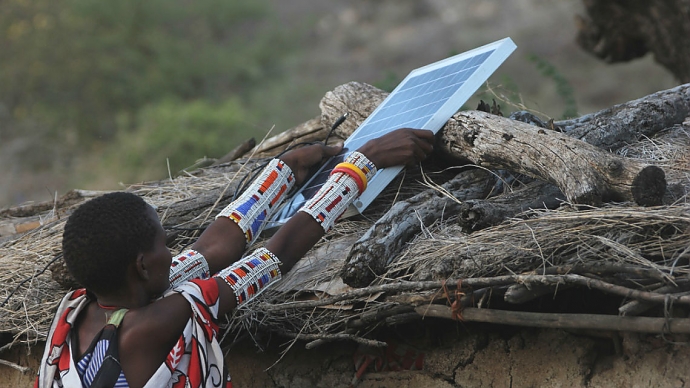

Maasai Learning & Solar Access Initiative
This project provides affordable solar light to 4,400 households. LED lights enable villagers to read, study and work, eliminating kerosene lanterns and improving health while reducing CO2 emissions.
Challenge
Kerosene lamps in rural Tanzania contribute significantly to illness and death due to indoor air pollution and fires. They limit education, without the ability to study after dark, and they introduce significant CO2 emissions. They increase poverty, a large percentage of a village household's income is spent on kerosene, and they limit commercial activities. You can break the cycle of poverty, ignorance and disease by providing affordable solar lighting to some of the world's poorest people.
Long-Term Impact
Long-term this project benefits the health of the families, the education of the children and parents, their income potential and the planet as a whole. Just these 4400 lighting systems will result in 135 tons of avoided CO2 pollution over 5 year
Powering the conditions for learning.
In remote Maasai communities, access to reliable electricity can be an overlooked barrier to education.
When learning spaces lack dependable power, opportunities for evening study, digital learning, teacher preparation and access to educational resources can remain limited.
The Maasai Learning & Solar Access Initiative is designed to address this gap through community-informed, solar-powered education infrastructure.
Rather than treating solar energy as an end in itself, the initiative focuses on one question:
How can clean, reliable energy create better conditions for children to learn?
Our approach
Agama Charity will work with communities, educators and relevant local stakeholders to identify learning spaces where solar energy can provide meaningful educational value.
Each participating site can be assessed according to:
- Existing access to electricity
- Number and age range of learners served
- Learning needs and hours of use
- Teacher and community requirements
- Appropriate solar capacity
- Equipment and maintenance requirements
- Long-term community ownership
The objective is to develop solutions that are appropriate, maintainable and measurable.
What the investment can support
Solar Learning Infrastructure
Installation of appropriately sized solar systems, lighting and essential electrical infrastructure for selected learning spaces.
Learning Technology
Where appropriate, solar power can support educational devices, charging facilities and offline digital learning resources.
Teacher Enablement
Reliable energy can help educators prepare lessons, access teaching materials and use appropriate digital resources.
Extended Learning Opportunities
Safe, appropriately supervised learning spaces can provide children with additional opportunities to read and study beyond daylight hours.
Community Ownership
Local participation, basic system awareness and maintenance planning can help protect the investment beyond the initial installation.
Measuring what matters
Major donors need more than photographs of completed installations.
Agama Charity will aim to monitor outcomes such as:
Learning spaces powered
How many education sites receive functioning solar infrastructure?
Children reached
How many learners regularly benefit from the improved learning environment?
Teachers supported
How many educators gain access to improved teaching resources?
Learning access
How is the availability and use of learning spaces changing?
Digital access
Where provided, how frequently are educational devices and resources being used?
System performance
Are installations functioning, maintained and delivering the intended service?
Community participation
Is there a clear local mechanism for oversight and maintenance?
Where baseline information is available, results should be measured against it rather than relying only on activity counts.
Built for sustainability
The initiative is designed around the principle that installation is only the beginning.
Before implementation, each project should have:
- A site assessment
- A defined education objective
- Appropriate technical specifications
- A maintenance plan
- Local responsibility for oversight
- A replacement/repair strategy
- A monitoring framework
- Transparent financial documentation
This approach helps ensure that donor funding creates an asset that can continue serving children beyond the initial project period.
A partnership, not a handout
The Maasai Learning & Solar Access Initiative is built around partnership with communities.
Children and families should not be viewed simply as recipients of assistance. They are participants in a long-term effort to strengthen access to education while respecting local culture, priorities and knowledge.
For donors, this creates an opportunity to support something tangible and measurable:
clean energy infrastructure designed around educational outcomes.
From one learning space to a scalable model
The initiative can begin with a carefully selected pilot.
The pilot would establish baseline data, document implementation costs, measure usage and identify lessons before expansion.
If the model demonstrates meaningful educational value and operational sustainability, it can be adapted and expanded to additional communities.
The ambition is not simply to install more solar systems.
It is to build a scalable model for bringing reliable learning environments closer to children who remain underserved by conventional infrastructure.
An investment in possibility
A solar system is infrastructure.
But the purpose of this infrastructure is human.
A light switched on after sunset can mean another page read.
A powered device can open access to a new lesson.
A reliable learning space can give a teacher another opportunity to teach.
The ultimate investment is not in the panels.
It is in the possibilities they help create.